

When Prayer Feels Pointless...
Here’s What It’s Actually Doing
If you’ve ever prayed and walked away thinking, “I’m not sure that did anything,” you’re not broken—and you’re not alone.
For a lot of people, prayer is one of the most confusing parts of faith. We know we’re supposed to do it. We hear verses about asking, seeking, and trusting God. We’re told prayer is powerful. And yet, when life gets heavy, prayer can start to feel frustrating—or even pointless.
You pray for healing, and nothing changes.
You pray for peace, and anxiety still shows up.
You pray for clarity, and everything feels just as cloudy as before.
That tension leads to honest questions:
• Does God actually hear me?
• Why does God answer some prayers and not others?
• Am I doing this wrong?
• If God already knows what I need, why am I saying it out loud?
Those questions aren’t signs of weak faith. They’re signs of real people trying to live real lives under real pressure.
Prayer Isn’t a Formula
One of the biggest misunderstandings about prayer is treating it like a formula. If I say the right words, with the right tone, enough times, then God will respond the way I want Him to.
But life doesn’t work that way. And Scripture doesn’t promise that kind of transactional relationship with God.
In Philippians, Paul writes about prayer in the middle of conflict, stress, and tension. He isn’t offering a motivational quote meant for perfect days. He’s speaking into messy ones. When he says to “pray about everything” (Philippians 4:6), it’s not because prayer guarantees immediate results. It’s because prayer keeps us grounded when life feels out of control.
Prayer isn’t about controlling outcomes.
It’s about staying connected when outcomes are uncertain.
Prayer Isn’t Plan B — It’s Plan A
For many of us, prayer becomes the last thing we do. We plan, stress, talk it through, try to fix it, replay conversations in our heads—and then, when nothing else works, we pray.
But prayer was never meant to be a backup option.
When prayer comes first, it realigns us. It reminds us that our peace, wisdom, and hope don’t come from how capable or prepared we are. They come from God.
That matters whether the problem feels small or overwhelming. Even small challenges can quietly pull our trust away from where it belongs when we rely only on ourselves. Prayer recenters us and reminds us who our source actually is.
Prayer Is About Honesty — Not Pretending
Paul encourages believers to “tell God what you need” (Philippians 4:6). That sounds simple, but it’s often the hardest part.
Many of us learned—directly or indirectly—that prayer is about sounding put-together. Being grateful enough. Faithful enough. Calm enough.
But God isn’t interested in polished prayers.
If you’re overwhelmed, you don’t need to hide that.
If you’re angry, confused, grieving, or exhausted—you don’t need to clean that up first.
Prayer isn’t about informing God of what’s happening. He already knows. It’s about bringing your real self into the conversation.
God doesn’t bless who you pretend to be.
He meets you where you actually are.
Prayer Is Also Worship — Remembering Who God Is
Paul also talks about gratitude—thanking God for what He’s already done (Philippians 4:6). That isn’t about pretending everything is okay. It’s about grounding ourselves in truth.
When life feels chaotic, worship reminds us that chaos doesn’t get the final word.
Fear is real—but it isn’t in charge.
Anxiety is loud—but it isn’t ultimate.
Your circumstances are heavy—but they’re not permanent.
Worship doesn’t erase pain. But it reframes it. It reminds us who God is, even when we don’t yet see what God is doing.
Peace Comes Before the Circumstances Change
This is one of the most surprising parts of Paul’s message.
He doesn’t say peace comes after everything works out.
He says peace comes after we pray and re-anchor ourselves to God (Philippians 4:7).
That means peace isn’t tied to perfect outcomes.
It’s tied to where your life is anchored.
Sometimes nothing around you changes. The situation is still hard. The pressure is still there. The answers are still unclear.
And yet—something shifts inside you.
You’re not spiraling the way you expected.
You’re not panicking the same way.
You don’t have clarity, but you have steadiness.
That’s the kind of peace Paul describes. Not denial. Not avoidance. But a deep calm that doesn’t fully make sense and doesn’t depend on everything going right.
Prayer Changes Us Before It Changes Anything Else
Here’s what we often miss:
Prayer may not immediately change your situation.
But it almost always changes you.
Over time, prayer reshapes our desires. It softens our hearts. It redirects our focus. It grows compassion and trust. It forms us into people who can carry peace even when life is heavy.
As we change, our prayers change too.
What once sounded like, “God, fix this now,” slowly becomes, “God, shape me through this.”
What once centered on ourselves begins to include others.
What once focused on relief grows into deeper trust.
That kind of transformation doesn’t happen overnight—but it happens when prayer becomes a place of connection instead of control.
So… What’s the Point of Prayer?
Prayer isn’t about convincing God to do what we want.
It’s about reconnecting with the One we actually need.
It’s not about perfect words.
It’s about honest hearts.
It’s not about escaping pressure.
It’s about being formed through it.
And when prayer realigns us with God—our source of peace, hope, and life—we discover something unexpected:
Even when nothing around us changes,
we’re no longer facing it alone.
And that changes everything.
Under Pressure: What’s the Point of Prayer?
Why pray if God already knows? Discover how prayer forms us, re-centers our hearts, and leads to peace.
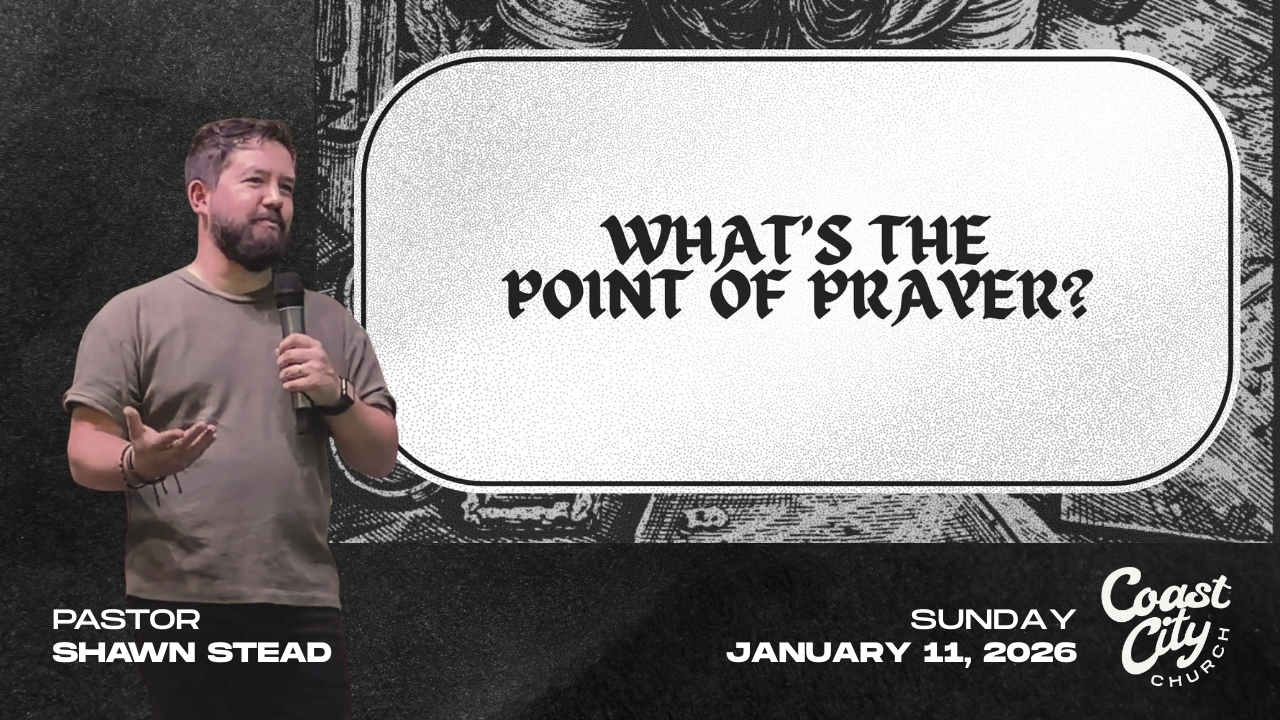
What's the Point of Prayer?
Why pray if God already knows? Discover how prayer forms us, re-centers our hearts, and leads to peace—even under pre...
Got more questions?
If you ever want to talk or want to follow up with more questions, give us a shout! And if you're in the Biloxi area, come visit us in person at Coast City—we’d be happy to meet you! Reach out to us anytime—we’d love to hear your thoughts!

Copyright 2026 Coast City Church
All Rights Reserved.