Rest Isn’t a Finish Line
How God Invites You to Start from Peace
If you’re honest, you probably treat rest like a reward. You push through the week, you grind, you survive the chaos, and you tell yourself: “One day, I’ll finally slow down.” Maybe it’s after the promotion. After the kids get older. After the busy season. After retirement. After you hit a certain number in the bank account.
But here’s the problem: even when we get what we thought would bring rest… it often doesn’t. We can be “off work” and still feel on edge. We can be on vacation and still feel restless. We can achieve a dream and still feel empty.
So what if we’ve been chasing the wrong definition of rest?
God’s Definition of Rest Isn’t “No Work”
When God gave Israel the Ten Commandments, He included something interesting in the Sabbath command. Not only does God say to take a day of rest—He explains why.
In Exodus 20:8–11, God says to “remember the Sabbath day” and keep it set apart. Work six days, then stop on the seventh. And then God gives the reason: He created everything in six days, and on the seventh He rested—so He blessed that day and declared it holy (a day set apart).
That matters because Israel didn’t come from a restful culture. They had just lived as slaves in Egypt for generations. They weren’t used to stopping. Their world trained them to keep producing, keep moving, keep building—no matter the cost.
Sound familiar?
Our world still runs on more: more money, more productivity, more noise, more pressure, more stuff. Even when we have full closets, full garages, and full schedules… we can still feel like it’s “not enough.”
So God doesn’t point His people to Egypt’s version of success for a model of rest. He points them to Himself.
Rest Is the Product of Joy, Not Exhaustion
Genesis describes God’s “rest” after creation:
In Genesis 2:1–3, God finishes His work, rests on the seventh day, and then blesses the day and declares it holy.
Here’s the shift: God didn’t rest because He was worn out. God is not running out of energy. He rested because the work was complete—and He delighted in what He had made.
That means biblical rest isn’t mainly about collapsing from exhaustion. It’s about living from a place of confidence: God is at work, God is good, and God is enough.
So instead of rest being the leftover scraps after we’ve “done everything,” rest becomes a response to God’s finished work—not our never-ending work.
And honestly, this flips how many of us operate. We say, “I need a day off because I’ve been working like crazy.” And God gently says, “You’ve got it backwards. Rest comes first.”
Rest Is the Starting Point, Not the Finish Line
This is one of the most powerful pictures in the creation story: humanity is created on day six. Which means when Adam wakes up to his first full day alive, it’s day seven.
Adam’s first full day wasn’t hustle. It was Sabbath.
God gave humanity purpose, responsibility, and work to do—but He didn’t start them from striving. He started them from rest.
So many of us live like rest is the finish line:
• “I can’t wait until Friday.”
• “I can’t wait until vacation.”
• “I can’t wait until things calm down.”
But Sabbath says something different: rest isn’t a finish line you reach—rest is a foundation you build from. It’s already available. God already blessed it.
So What Is Sabbath?
A lot of people hear “Sabbath” and think it just means taking a day off. But in Genesis 2, God does more than stop working. He does two things:
1. He blesses the day
2. He declares it holy (set apart)
That gives us a simple, practical definition:
Sabbath is joy + worship.
It’s a day (or time) where you enjoy God’s gifts and you deliberately remember God Himself.
This doesn’t mean you have to sit in silence for 24 straight hours like a monk. The point isn’t to make Sabbath another burden. Jesus teaches that God’s gifts are meant to bring freedom, not slavery.
But it does mean we choose a rhythm where we stop long enough to say:
• “God, You’re God and I’m not.”
• “These blessings came from You.”
• “You’re the source of my life and joy.”
Then, from that place of worship, we enjoy what God has provided: time with family, a meal, a walk outside, a hobby, art, a good conversation—whatever fills you up instead of draining you.
How Rest Forms Us
Here’s where Sabbath becomes more than a self-care idea. Rest actually shapes us.
When you stop and notice God’s blessings, something happens: gratitude grows. And gratitude changes the direction of your life.
Over time, rest produces a rhythm:
• Rest leads to gratitude (because you finally stop long enough to notice what’s good)
• Gratitude leads to generosity (grateful people tend to hold things with open hands)
• Generosity leads to joy (there’s a special kind of joy that comes from giving)
• Joy leads back to rest (because joyful people stop to savor, worship, and breathe again)
That’s how God forms us into people of rest—not in one dramatic moment, but through a steady practice.
A Simple Step to Try This Week
If Sabbath feels impossible right now, don’t start with pressure. Start with intention.
Pick a small “Sabbath moment” this week:
• 20 minutes on your porch with your phone away
• a slow meal with gratitude and prayer
• a walk where you talk to God and notice His creation
• an hour doing something life-giving, then ending it with worship
The goal isn’t perfection. The goal is alignment.
Because rest isn’t just what happens when life finally calms down. Rest is what happens when you remember who’s really in control.
And that’s where peace starts.
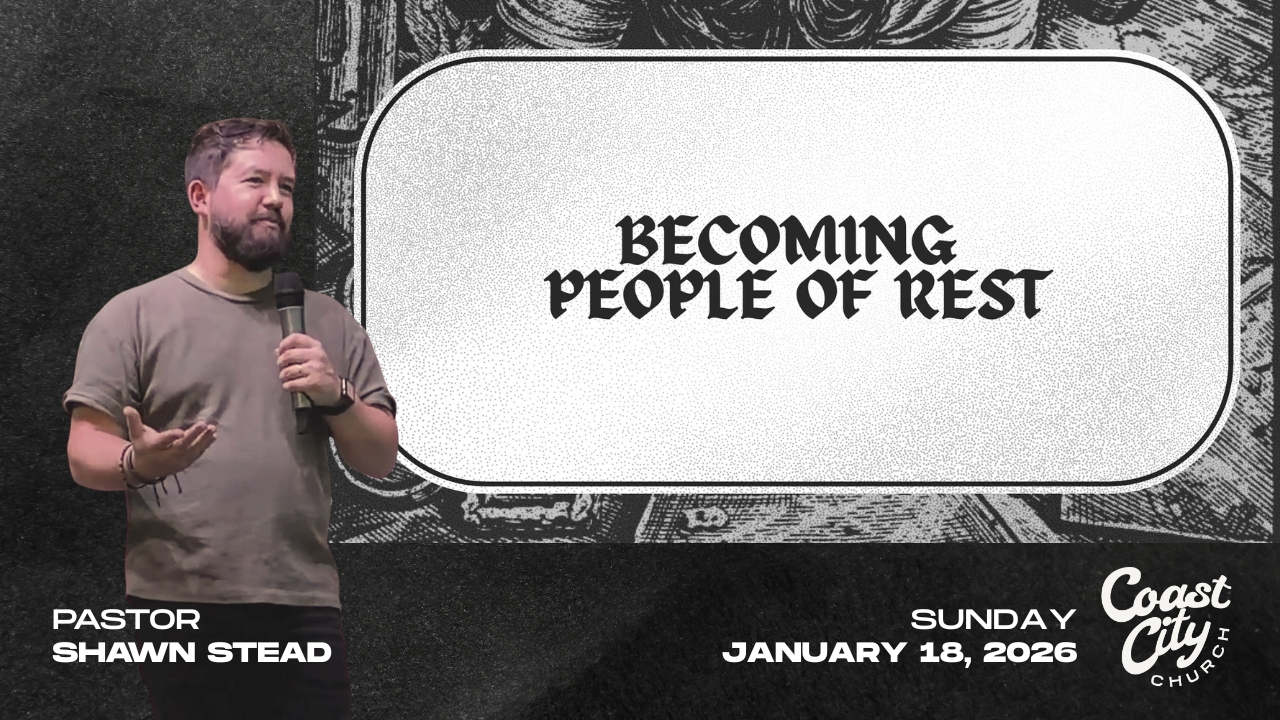
Becoming People of Rest
Discover God’s definition of Sabbath: rest as joy and worship. Learn how biblical rest forms gratitude, generosity, and joy.
Becoming People of Rest
Discover God’s definition of Sabbath: rest as joy and worship. Learn how biblical rest forms gratitude, generosity, a...
Got more questions?
If you ever want to talk or want to follow up with more questions, give us a shout! And if you're in the Biloxi area, come visit us in person at Coast City—we’d be happy to meet you! Reach out to us anytime—we’d love to hear your thoughts!

Copyright 2026 Coast City Church
All Rights Reserved.